
10 Sydney Bathroom Trends for 2027
Warmer, softer and a lot more practical than the bathrooms of five years ago. Here's what Sydney homeowners are actually choosing this year — and the three looks that have quietly had their day.
- 35 Years' Experience
- 4.9 ★ · 200+ Reviews
- Taren Point Showroom
Bathrooms don't get redone often. Most people we meet are living with a bathroom that went in fifteen or twenty years ago, and they want the next one to still look right in 2040. That makes trends a slightly awkward subject — nobody wants to spend serious money on something that will date.
So this isn't a list of things that are having a moment. It's the ten directions bathroom design has genuinely moved in, why each one has staying power, and how to use it in a normal Sydney home rather than a magazine shoot. If you only take one thing from it: the big shift is away from cold and perfect, and towards warm, textured and easy to live with.
- Warm neutrals have replaced crisp white as the default bathroom palette — putty, mushroom, greige and warm taupe.
- Large-format tile is the single easiest way to make a small bathroom feel bigger and cut cleaning time.
- Freestanding baths are still in, but the shape has changed: softer, shallower and smaller than the tubs of 2020.
- Brushed and satin tapware finishes have overtaken high-gloss chrome, and they hold up better near the coast.
- Matching every finish in the room now reads as builder-grade rather than considered.
- Curbless showers and floating vanities are the two upgrades that do the most for both feel and resale.

Natural Materials, Warm and Tactile
If there's one trend underpinning all the others, it's this. Bathroom design has moved decisively towards materials you'd want to touch — stone with visible movement, timber-look grain, honed rather than polished surfaces, tile with a bit of variation across the face.
The reasoning is partly practical. Perfectly flat, glossy finishes show every water mark and every fingerprint. Surfaces with texture and tonal variation hide daily life much better, which matters a great deal in a room used by four people before 8am.
For vanity tops, we remove the old benchtop entirely and template a new one to fit the space. Quantum Zero Engineered Stone in 20mm or 40mm gives you the stone look with the durability a bathroom needs, and Quantum Porcelain is worth a look if you want something even harder-wearing for a family bathroom.
One thing to watch: mixing three or more strong materials in a small room gets busy fast. Two hero materials plus one quiet supporting finish is usually the ceiling in a standard Sydney bathroom.

Warm Neutrals Instead of Crisp White
The all-white bathroom had a very long run, and it's over. The replacement isn't colour exactly — it's warmth. Putty, mushroom, greige, warm taupe, soft clay. Colours that read as neutral but have something underneath them.
Part of this is aesthetic; the cool grey-and-white bathrooms of the 2010s now look flat and a bit clinical. But there's a practical argument too, and it's the one that convinces most of our clients: warm neutrals hide water spots, soap residue and general wear far better than stark white. They also sit comfortably alongside timber, stone and brass, all of which are having their own moment.
You don't need to commit to the whole room. A warm-toned floor tile with white walls, or a putty vanity against a pale tiled wall, gets you most of the way there.

Large-Format Tile and Fewer Grout Lines
This is the trend we'd push hardest for anyone with a small bathroom, which in Sydney is most people.
Large-format tile — think 600×1200mm and up — does two things at once. Visually, fewer grout lines means fewer visual interruptions, and the eye reads the space as bigger and calmer. Practically, grout is the part of a bathroom that ages worst. It stains, it grows things, and it's the first thing that makes a clean bathroom look dirty. Less of it is simply less to maintain.
It's also part of why the shaped-tile trend has cooled off. Fish-scale and scalloped tiles are grout-heavy by nature, so they ask more of you in maintenance than a large-format wall does.
Pattern still works beautifully — the current move is to give it one contained place, like a shower niche or a single feature wall, and keep the surrounding surfaces large and quiet so the feature has room to breathe.

Clean Lines, Without the Cold
Clean lines are still the foundation of good bathroom design. Uncluttered sightlines, concealed storage, nothing sitting on the bench that doesn't need to be there. That hasn't changed and won't.
What has changed is the temperature. The stripped-back, all-white, storage-free minimalism of a few years ago is now the thing designers are actively moving away from — partly because it looked cold, and mostly because it didn't work. A bathroom with no storage is a bathroom with everything on the bench within a month.
The current version keeps the clean lines and adds warmth back through material and light. Same restraint, better room to live in.
Freestanding Baths, Softer and Smaller
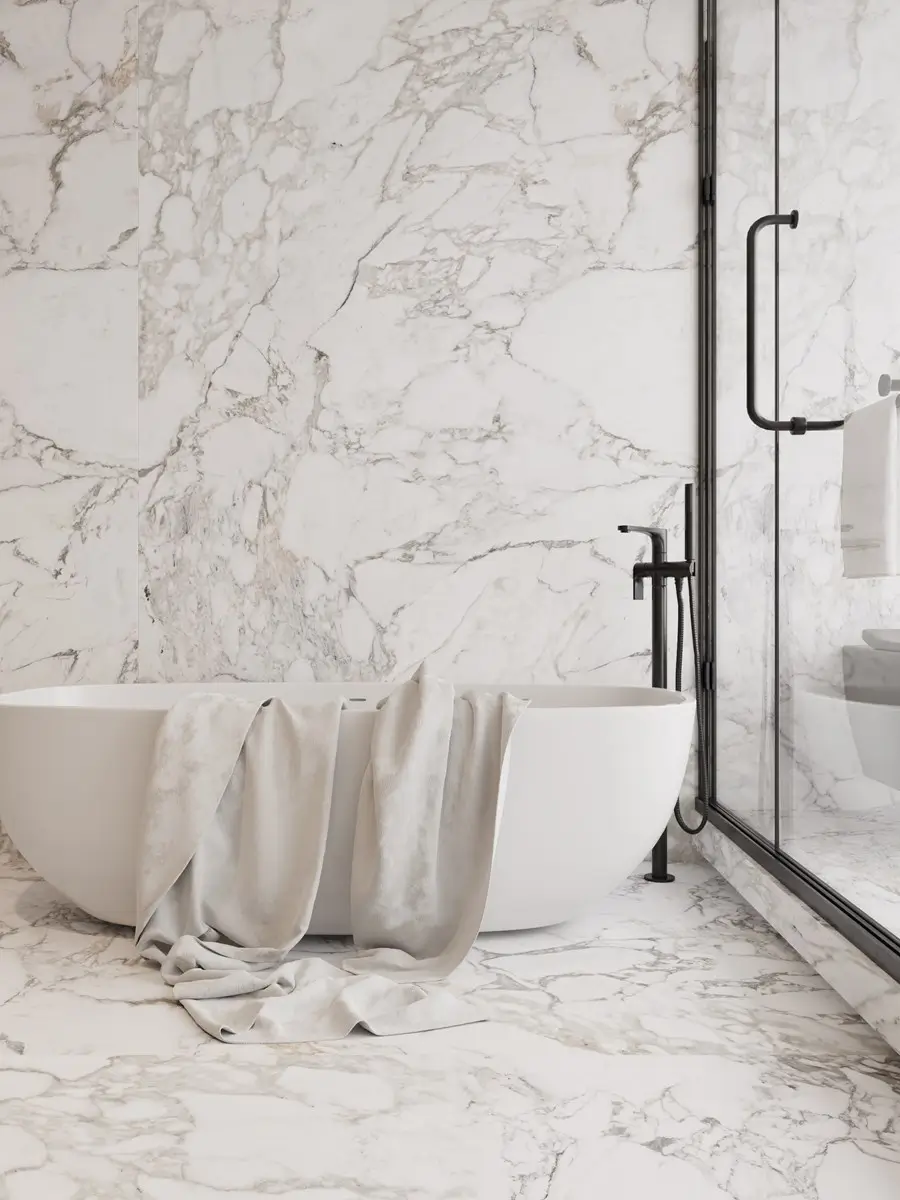
Freestanding baths are still very much in. The shape is what's moved.
The oversized statement tubs of 2020 to 2022 are giving way to softer oval silhouettes with shallower ends and a smaller overall footprint. That's partly a design shift and partly reality catching up — a huge bath in a normal-sized bathroom eats the floor space, takes forever to fill, and often ends up used twice a year.
The smaller profile means a freestanding bath is now genuinely realistic in a compact Sydney bathroom or an apartment, which it often wasn't before. You get the statement without giving up the room.
Worth asking yourself honestly: do you bathe? If the answer is no and you're not planning children, a larger, better shower will serve you more. Resale is the counter-argument — a home with no bath at all narrows the buyer pool.

Brushed and Satin Tapware, Thoughtfully Mixed
High-gloss chrome has stepped back and brushed or satin finishes have taken the lead. Brushed nickel, brushed brass, matte black, gunmetal.
The practical case is strong: brushed finishes show fingerprints and water marks far less than polished chrome or gloss black, which means they look new for longer with less effort. If you're anywhere near the coast — and a lot of the Shire and the Eastern Suburbs is — it's worth asking your supplier about PVD finishes, which hold up considerably better in salt air and humidity.
The bigger shift is that everything no longer has to match. Matching every metal, every fitting and every finish from the same range is now what reads as builder-grade. A mix — brushed brass tapware with matte black hardware, say — looks considered rather than ordered off one page. Two metals is the sweet spot. Four is chaos.
Layered Lighting, Not Just a Lit Mirror
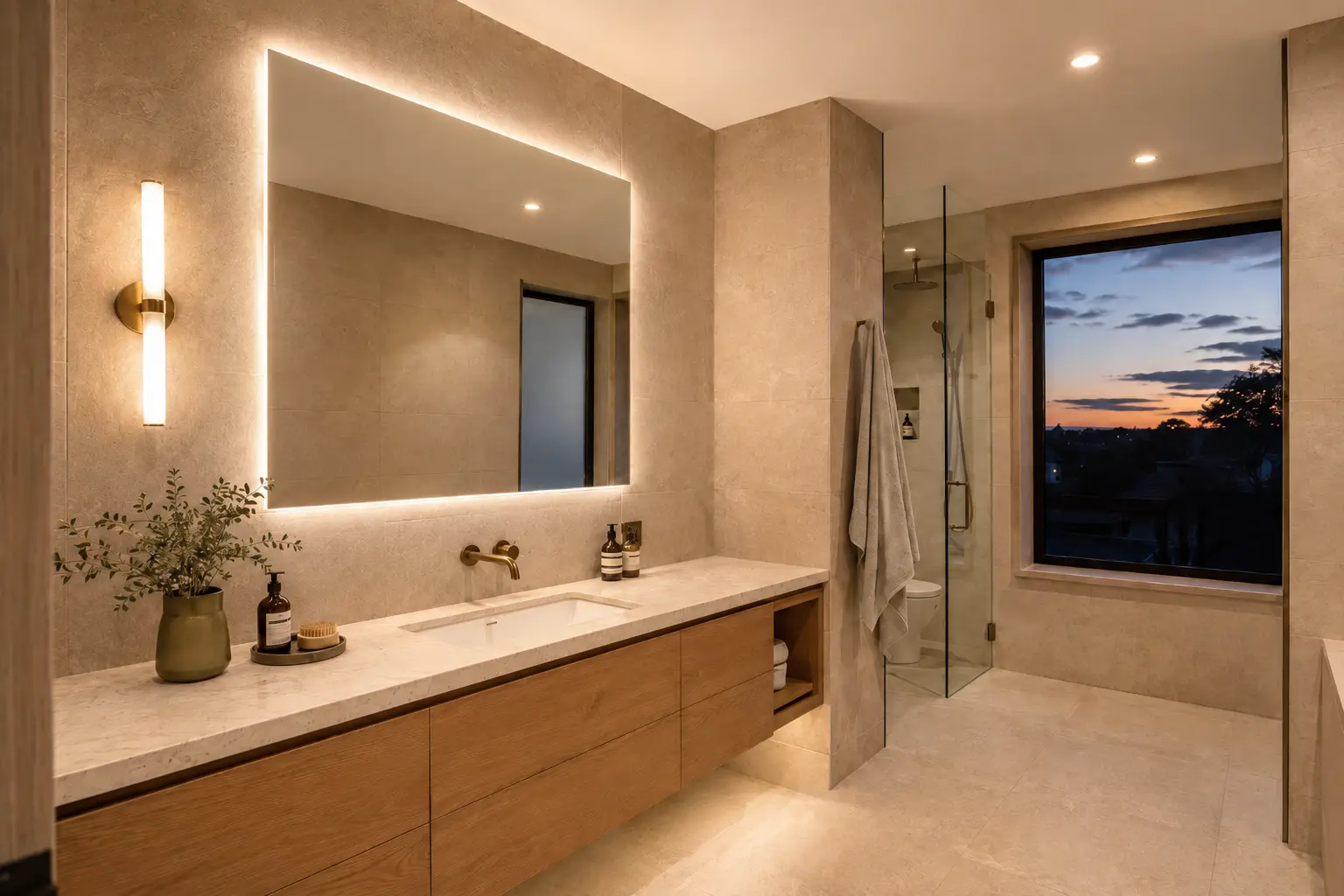
Backlit mirrors were the trend that got everyone's attention, and they're still excellent — soft, flattering, and they make a small bathroom feel far more expensive than it is.
But the more useful idea is layering. A bathroom does at least three different jobs, and one ceiling downlight can't do all of them. The current approach runs three layers: general light overhead, task light at the mirror where you actually need to see your face, and something soft and low for evening.
Put the mirror and the ambient layer on a dimmer. It costs very little at rough-in and it's the difference between a bathroom you can shave in at 6am and one you can relax in at 10pm.
On mirror sizing — spanning the full width of the vanity is the general rule, and in a narrow bathroom a wall-to-wall mirror is the single cheapest way to double the apparent size of the room.

Floating Vanities and Storage You Can't See
A wall-hung vanity with the floor running underneath it is one of those details that seems minor and isn't. Seeing the floor continue under the cabinet makes the room read as larger, and it removes the grim strip of floor behind a floor-standing unit that nobody has ever cleaned properly.
The other half of the trend is storage that's genuinely hidden. Mirror cabinets, drawers rather than cupboards, a recessed niche in the shower instead of a caddy hanging off the tap. Open shelving looked lovely in photographs and turned out to be a dust-and-damp trap in real bathrooms.
Structural note: a floating vanity needs proper wall support and, depending on the wall, sometimes noggins added behind the plasterboard. It's straightforward if it's planned. It's expensive if it's an afterthought.

Curbless Showers
A shower with no step at the entry — the floor simply runs in, graded to the waste. It's one of the strongest trends going and one of the few that improves a bathroom on every measure at once.
It looks better, because there's no visual break in the floor. It's easier to clean, because there's no lip collecting hair and soap. It's dramatically more accessible, which matters if you're planning to stay in the house. And it's consistently named among the upgrades that return the most at resale.
One correction on this trend, though: the enormous open wet room is on the way out. The idea of a shower the size of a room has given way to smarter, more considered use of the space — a well-planned curbless shower with a glass panel, and the floor area you save going into storage or a bigger vanity.
Be aware: curbless needs the floor waste and falls designed properly, and in some cases a slight drop in the substrate. It's a decision to make at planning, not one to add later.

Texture Over Gloss
The last one ties the rest together. High-gloss cabinetry, acrylic wall panels and shiny synthetic finishes are falling out of favour across the board.
What's replacing them is anything with a hand to it — ribbed and fluted profiles used sparingly, honed stone, matte tile, limewash-look wall finishes, textured feature tiles. Surfaces that catch light unevenly instead of bouncing it straight back.
A word of caution on fluting specifically. It's been so widely used on vanity fronts over the last three years that it's already starting to read as dated to designers. If you love it, use it in one place rather than across every cabinet face — a fluted vanity in an otherwise plain room, not fluted everything.
Three Bathroom Looks on the Way Out
Worth knowing before you commit, because these are all still widely sold.
The All-White, All-Cool-Grey Bathroom
Crisp white with grey accents is the single fastest way to date a new bathroom right now. It reads as 2015. Warm the palette and you fix most of it.
Everything Matching
One tapware range, one hardware finish, one tile, all from the same page of the same catalogue. It's the safe choice and it's exactly what makes a bathroom look builder-grade. Vary at least one element deliberately.
High Gloss on Everything
Gloss cabinetry, polished chrome and shiny wall panels together make a room feel harder than it needs to. Gloss used once as a highlight is fine — it's gloss on every surface at once that now reads as dated.
How to Use Any of This Without Dating Your Bathroom
The rule we give clients is simple. Put your money into the things that are difficult and expensive to change — layout, tiling, the shower, the vanity, the stone. Keep those warm, plain and well made. Then take your risks on the things that are cheap to swap: tapware, mirrors, lighting, paint, towels.
A bathroom built that way absorbs a change of taste. One where the trend is baked into the tiling doesn't.
If you're not sure which side of that line something falls on, that's exactly the sort of thing worth talking through before you commit. Our team designs bathrooms across Sydney's south, east and north, and there's no charge and no obligation for an in-home consultation.
Bathroom Trends, Answered
What is the biggest bathroom trend in 2027?
Warm neutrals replacing crisp white. Tones like putty, mushroom, greige and warm taupe have taken over from the stark white and cool grey palettes that dominated the last decade. They look warmer, and they hide water marks and everyday wear far better.
Are freestanding baths still in style?
Yes, but the shape has changed. Softer oval silhouettes with shallower ends and a smaller footprint have replaced the oversized freestanding tubs of a few years ago. The smaller profile makes a freestanding bath realistic in a compact bathroom, which it often wasn't before.
Is white tile out of date?
White tile isn't out, but an all-white bathroom with cool grey accents now looks dated. The fix is usually warmth rather than colour — a warm-toned floor, a timber-look vanity or brushed brass tapware is often enough to lift a white bathroom without retiling it.
Which bathroom upgrades add the most value?
Curbless walk-in showers, durable stone or porcelain surfaces, good layered lighting, warm neutral colours and water-efficient fixtures. Timeless, well-built improvements appeal to the widest range of buyers and return more than highly styled or personalised finishes.
What bathroom trends date the fastest?
Anything built into the tiling, because it's the most expensive element to change your mind about. Trends applied through tapware, mirrors, lighting and paint are far safer, since they can be swapped without retiling.
Thinking About Your Bathroom?
Come and see the materials in person. Our Taren Point showroom has the stone, porcelain and cabinet finishes on display so you can put them next to each other rather than guessing from a screen. Or we'll come to you — a free in-home consultation, measurements and honest advice on what your space can take.
35 years in the industry. Over 25,000 installations. 200+ Google reviews at 4.9 stars.